The published lifespan for a typical outdoor kitchen is 15-25 years with proper maintenance, and many last even longer. That is a wide range, and the width is the point: nothing about an outdoor kitchen ages at one speed. A masonry block island with a stucco finish is published at 25 yrs, a stone veneer masonry island with a granite counter at 30 yrs, a framed island with a poured concrete counter at 15 yrs. The difference is not luck. It is the material system you chose, plus three habits — re-sealing on the published interval, keeping covers on, and walking the structure once a year to find water before it finds the base.
The Re-Seal Clock, Material by Material
Every material system in the published model carries its own re-seal interval and its own annual maintenance figure, and both belong in the buying decision rather than in a drawer afterwards:
| Material or system | Lifespan | Re-seal interval | Annual maintenance |
|---|---|---|---|
| Stone veneer masonry with granite counter | 30 yrs | 4 yrs | 200 |
| Masonry block island with stucco finish | 25 yrs | 3 yrs | 150 |
| Kitchen under a pergola or patio cover | 25 yrs | 3 yrs | 220 |
| Modular stainless cabinets with stone top | 20 yrs | 0 | 80 |
| Bar-height counter run only (no appliances) | 20 yrs | 2 yrs | 120 |
| Framed island with poured concrete counter | 15 yrs | 2 yrs | 250 |
Two of those rows explain themselves. Modular stainless publishes a re-seal interval of 0 — fast to install and can be reconfigured later — while a framed island with a poured concrete counter is the cheapest permanent route and the counter needs sealing more often. That is the trade in one line: the cheapest permanent option is also the one with the shortest published lifespan and the highest annual maintenance figure.
Why Re-Sealing Is Not the Same as Cleaning
Cleaning removes what sits on the surface. Re-sealing restores the surface's ability to keep water and oil out of it, and the two jobs run on completely different schedules. Published guidance is that countertops must be UV-resistant and handle thermal shock from hot pans, and that granite and quartzite should both be sealed, with quartzite handling heat, sun, and acidic spills with fewer problems.
Covers Are Inexpensive Insurance
Stainless steel appliances rated for outdoor use handle winters fine, but a cover or pergola dramatically extends their life by keeping them out of direct sun and rain. Grill covers are inexpensive insurance, and the published counterfactual is blunt: appliances left uncovered in direct sun lose their finish and seals within a few years.
Shade is the other half of the same decision, because shade protects the finish and makes the space usable. Published coverage and price bands are a cantilever umbrella at 45% coverage, 1,200–3,500; a pergola with adjustable slats at 70% coverage, 4,500–12,000; and a solid patio cover at 90% coverage, 9,000–25,000. Cedar pergolas resist rot and insects naturally, while an aluminum patio cover with an insulated solid roof blocks 100% of UV and rain.
The Annual Walk
One pass a year, no equipment required: walk the perimeter looking for soil or mulch against the base, tap the counter for a hollow tone, trace every water line to where it enters, and photograph the same spots annually. The photographs are the part people skip and the part that works, because a change too gradual to notice in July is obvious against last year's frame.
The Local Variable Worth Asking About
If the ground under the slab in Orlando is the variable you have not had explained yet, ask for it in writing: Orlando sits on deep, rapidly permeable sands. The USDA-NRCS Orlando series, the area's namesake soil, is 'very deep, well drained, rapidly permeable' fine sand with silt plus clay under 12 percent in the 10-to-40-inch control section and a water table below 72 inches (https://soilseries.sc.egov.usda.gov/OSD_Docs/O/ORLANDO.html); the excessively drained Candler fine sand is the other major upland series (https://soilseries.sc.egov.usda.gov/OSD_Docs/C/Candler.html). Low, flat ground and lake margins instead map as Myakka sand — Florida's official state soil — which is poorly drained with a seasonal high water table that rises to within roughly 18 inches of the surface for part of the year (https://soilseries.sc.egov.usda.gov/OSD_Docs/M/MYAKKA.html). For anchoring an outdoor-kitchen island that means setting footings on compacted native sand below the seasonal water table — typically a spread concrete footing, pier or thickened slab rather than pavers or a block base set directly on grade — because the sand drains fast but a rising water table can heave or settle anything unanchored; confirm the mapped series and depth-to-water for the exact parcel in the NRCS Web Soil Survey (https://websoilsurvey.nrcs.usda.gov/).
Frequently asked questions
How long does an outdoor kitchen last?
15-25 years for a typical project with proper maintenance, and many last even longer. Material lifespans are published separately: 30 yrs for stone veneer masonry with granite, 25 yrs for masonry block with stucco and for a kitchen under a cover, 20 yrs for modular stainless and a bar run, and 15 yrs for a framed island with a poured concrete counter.
How often do countertops need re-sealing?
4 yrs for stone veneer masonry with a granite counter, 3 yrs for masonry block with stucco and for a kitchen under a pergola or patio cover, 2 yrs for a framed island with a poured concrete counter and for a bar-height run, and a published re-seal interval of 0 for modular stainless cabinets with a stone top.
Sources
- Orlando Outdoor Kitchens — outdoor kitchen cost calculator model (lifespans, re-seal intervals and annual maintenance)
- Orlando Outdoor Kitchens — outdoor kitchens FAQ (published lifespans and winter care)
- Orlando Outdoor Kitchens — structural audit walkthrough (annual walk and substrate order)
- NOAA National Centers for Environmental Information
Related
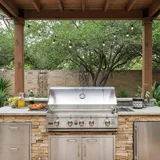
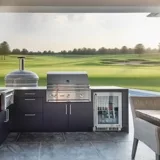
Outdoor Kitchens services in Orlando
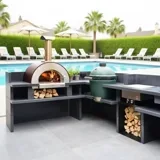
Orlando Outdoor Kitchen Construction
A built-in outdoor kitchen is a permanent structure before it is a cooking appliance, and the published numbers only make sense once you know which of the two you are paying for.
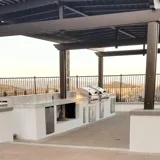
Orlando Outdoor Kitchen Pergola And Patio Cover
A shade structure is the part of an outdoor kitchen that decides how many months of the year the rest of it actually gets used.
Orlando Outdoor Kitchen Fireplace
An outdoor fireplace is built around one 1,800-degree event, and every part of the specification exists because of it.
Orlando Outdoor Kitchen Bar Construction
An outdoor bar is two jobs in one structure: a counter run built to bar height, and a small commercial beverage system with water, power and a drain.
Orlando Outdoor Kitchen Lighting
Outdoor lighting is specified in layers, not in fixtures, and any one layer on its own fails at exactly the job it was bought for.
Orlando Outdoor Kitchen Pizza Oven
A pizza oven is a masonry appliance: the heat is the easy part, and the footprint, the mass and the clearance to combustibles are what the build is really about.
Areas we serve
Orlando
Outdoor Kitchens in Orlando, FL - costs, water and soil notes.
Winter Park
Outdoor Kitchens in Winter Park, FL - costs, water and soil notes.
Kissimmee
Outdoor Kitchens in Kissimmee, FL - costs, water and soil notes.
Sanford
Outdoor Kitchens in Sanford, FL - costs, water and soil notes.
Apopka
Outdoor Kitchens in Apopka, FL - costs, water and soil notes.
Lake Mary
Outdoor Kitchens in Lake Mary, FL - costs, water and soil notes.
Windermere
Outdoor Kitchens in Windermere, FL - costs, water and soil notes.