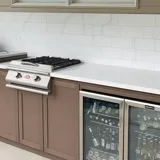
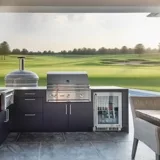
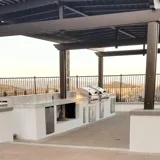
A custom outdoor fireplace is published as wood-burning or gas, with gas fire pits as the smaller alternative. The published cost bands are clear about scale: the fireplace-specific band is 12,000 to 40,000 depending on size and stone, an installed outdoor fireplace as an add-on to an existing kitchen is 2,000 - 8,000, and the site-wide project band is 15,000 and 35,000, with 25,000 to 50,000 published for a custom build that includes a pergola, refrigeration, cabinetry, sink and an outdoor fireplace. The published payoff is social rather than financial: adding a fireplace is reported to increase outdoor-space use by roughly twice as much. Orlando Outdoor Kitchens is a free matching service, not a provider - we route your request to licensed local builders and we do not employ contractors.
What it costs in Lake Mary
| Job | Published 2026 range |
|---|---|
| Built-in gas grill, installed | 1,500 - 5,000 |
| Pizza oven, installed | 1,000 - 8,000 |
| Outdoor-rated refrigerator | 800 - 3,500 |
| Sink with plumbing | 300 - 2,000 |
| Gas line run from the meter | 400 - 2,000 |
| Low-voltage lighting package | 500 - 1,500 |
| Running gas, water and electric lines together | 2,000 - 5,000 |
| Underground line runs and trenching | 500 - 2,000 |
| Permit allowance | $75 - $400 |
| Removal or demolition, per unit | 25 - 60 |
What an outdoor fireplace build actually involves
The published specification is a built structure, not a fire pit with a chimney. A custom fireplace is wood-burning or gas, with a firebrick-lined firebox that withstands 1,800-degree temperatures, a steel reinforced concrete cap over the firebox, and a stone veneer or full-bed stone exterior that matches the outdoor kitchen it sits beside. A built-in seating wall typically completes the assembly.
Those three details - the firebrick lining, the reinforced cap and the mass of the surround - are what separate a fireplace that lasts from a decorative box that cracks. Masonry works by storing heat and releasing it slowly, which is why the structure is heavy and why the footing under it matters more than the finish on it.
| Component | Published specification | What it does |
|---|---|---|
| Firebox | Firebrick-lined, withstands 1,800-degree temperatures | Contains the fire without spalling the masonry |
| Cap | Steel reinforced concrete cap | Closes the top of the surround against weather |
| Exterior | Stone veneer or full-bed stone | Matches the outdoor kitchen and protects the mass |
| Seating | Built-in seating wall | Turns the fireplace into a room, not an object |
| Base | A 4-inch reinforced concrete slab on compacted gravel | Carries the weight of masonry and the firebox |
Gas fire features are the lighter path. A gas fire pit or gas fireplace still needs a gas line run from the meter, a permitted connection and clearance to combustibles, but it does not need the mass of a wood-burning chimney and it starts with a switch rather than a fire.
Published cost bands and what size and stone change
The fireplace band is the one item that is published separately from the rest of the project, because size and stone drive it more than anything else does.
| Scope | Published band |
|---|---|
| Outdoor fireplace, depending on size and stone | 12,000 to 40,000 |
| Installed outdoor fireplace as an add-on | 2,000 - 8,000 |
| Typical project range | 15,000 and 35,000 |
| Custom build with pergola, refrigeration, cabinetry, sink and outdoor fireplace | 25,000 to 50,000 |
| Counter run, stone veneer masonry with granite counter | $400-670/lf |
| Counter run, masonry block island with stucco finish | $250-450/lf |
The spread inside the 12,000 to 40,000 band is explained by the same published cost drivers as the rest of the niche: appliances, countertop material, and utility runs are the big-ticket items, and prices vary by 30 to 40 percent for the same layout based on appliance brands and stone selection. A fireplace quoted as full-bed stone against the same footprint framed in veneer over block is a different structure with a different footing, which is why the two quotes should not be compared line by line.
Where the fireplace is fed by gas, add the published gas line run from the meter at 400 - 2,000, and allow for underground line runs and trenching at 500 to 2,000 that many quotes leave out. Running gas, water and electric lines to a new outdoor zone is published at 2,000 to 5,000.
Fire performance, clearances and Central Florida conditions
The published ventilation rule applies to every cooking and heat appliance in the zone: open-air builds need no mechanical ventilation, but covered or enclosed areas require a rated vent hood, because an under-counter appliance or an enclosed room without airflow traps smoke and heat, damaging finishes. A fireplace under a solid cover is exactly the case that rule is written for.
Gas appliances carry their own published requirement - proper ventilation for gas appliances and the code-required clearances - and the failure signals published for a gas line are specific: a gas smell, weak flame, or hissing at a fitting means the line needs attention immediately, and a licensed pro should pressure-test the line and confirm the system is safe before you cook. Stainless and weather-rated construction, sealed electrical connections, and covers rated for UV exposure are the published list for anything that lives outdoors.
Orlando has a humid subtropical climate: summer highs routinely push into the mid-90s F, relative humidity stays high most of the year, and afternoon thunderstorms arrive almost daily from June through September, so an outdoor kitchen gets used twelve months a year but is wet and sun-baked for much of it. Intense UV fades finishes, degrades plastics and weakens structural components over time, while heat plus humidity accelerates metal corrosion and drives mold and mildew in poorly ventilated cabinet cavities (https://riseconstruction.us/blog/florida-outdoor-kitchen-climate-ready-design-2026). The practical response in this market is a UV-stable, non-porous surface — granite, porcelain or properly sealed concrete rather than engineered quartz, which can discolor under long-term direct Florida sun — in a lighter color that absorbs less heat, with sealed seams, waterproof adhesives and 316 marine-grade stainless hardware (http://artstonesurfaces.com/outdoor-countertop-costs-in-orlando-budgets-edges-and-install-tips). shapes the rest of the specification. Materials published as holding up best in heat and humidity are powder-coated aluminum and stainless steel, along with stone or brick veneer for the structure, with pressure-treated or cedar frames working well when sealed properly. Around the footings, Orlando sits on deep, rapidly permeable sands. The USDA-NRCS Orlando series, the area's namesake soil, is 'very deep, well drained, rapidly permeable' fine sand with silt plus clay under 12 percent in the 10-to-40-inch control section and a water table below 72 inches (https://soilseries.sc.egov.usda.gov/OSD_Docs/O/ORLANDO.html); the excessively drained Candler fine sand is the other major upland series (https://soilseries.sc.egov.usda.gov/OSD_Docs/C/Candler.html). Low, flat ground and lake margins instead map as Myakka sand — Florida's official state soil — which is poorly drained with a seasonal high water table that rises to within roughly 18 inches of the surface for part of the year (https://soilseries.sc.egov.usda.gov/OSD_Docs/M/MYAKKA.html). For anchoring an outdoor-kitchen island that means setting footings on compacted native sand below the seasonal water table — typically a spread concrete footing, pier or thickened slab rather than pavers or a block base set directly on grade — because the sand drains fast but a rising water table can heave or settle anything unanchored; confirm the mapped series and depth-to-water for the exact parcel in the NRCS Web Soil Survey (https://websoilsurvey.nrcs.usda.gov/). and site drainage decide how the base is built: the slab should slope away from the structure, poor drainage leads to standing water, moss, and rusted appliance bases, and site drainage is one of the three things - weather patterns, soil characteristics, and building code requirements - that published guidance says to check before a design is finalized.
Local note for Lake Mary
Lake Mary's uplands are deep sandy series such as the excessively drained Candler sand and the well-drained Orlando sand, both rapidly permeable with negligible shrink-swell (https://soilseries.sc.egov.usda.gov/OSD_Docs/C/Candler.html), with poorly drained Myakka sand and a seasonal high water table around lake margins and flatwoods (https://soilseries.sc.egov.usda.gov/OSD_Docs/M/MYAKKA.html).
Lake Mary supplies its own water from six groundwater wells that draw from the upper Floridan aquifer and feed a single city water treatment plant, named for former Commissioner Harry Terry (https://lakemaryfl.com/342/2025-Water-Quality-Report). That plant treats the water with an ultraviolet light advanced oxidation process (UVAOP) using hydrogen peroxide, then granular activated carbon and chlorination before it is pumped into the distribution mains (same report). Utility questions go to the Director of Public Works at 407-585-1452, and after-hours water emergencies are routed through the Seminole County Sheriff non-emergency line at 407-665-6650 (same report).
Utility accounts: City of Lake Mary Utility (Public Works) · 407-585-1452
Checking a quote in Lake Mary
- Is the quote itemised for the island, the countertop, the appliances and the connections, or is it one lump sum?
- Who pulls the gas and electrical permits, and is that cost in the quote?
- Is the countertop templated after the island is built, and what happens if the measurement is wrong?
- Are the appliances supplied by the contractor or by me, and who handles their warranty?
- What is the workmanship warranty on the masonry and the countertop, separately from the appliance warranties?
Frequently asked questions
How much does an outdoor fireplace cost in Orlando?
The fireplace-specific published band is 12,000 to 40,000 depending on size and stone. Added to an existing outdoor kitchen, an installed outdoor fireplace is published at 2,000 - 8,000. For context, the typical project range is 15,000 and 35,000, and a custom build with a pergola, refrigeration, cabinetry, sink and outdoor fireplace is published at 25,000 to 50,000. A gas feed adds a published line run from the meter at 400 - 2,000.
Should I choose wood-burning or gas?
Both are published options, and the trade-off is in the specification. Wood-burning requires a spark screen and a code-compliant chimney height, and the local position on wood-burning with a proper spark arrestor should be confirmed with Inside Orlando city limits the City of Orlando Permitting Services Division (Economic Development Department) issues the residential building/structural, electrical, plumbing and fuel-gas permits an outdoor kitchen needs, and applications run through the online Digital Permits (ProjectDox) portal; it is located at City Hall, 400 South Orange Avenue, 1st Floor, Orlando, FL 32801, phone 407-246-2121 (https://www.orlando.gov/Building-Development/Permits-Inspections). A site plan and, for jobs over $5,000, a recorded Notice of Commencement are required, and homeowner-performed work needs a signed Owner/Builder Declaration submitted in person at the Permitting Services office (https://www.orlando.gov/Building-Development/Permits-Inspections/Get-a-Permit/Permitting-Checklists/Residential-Permitting-Requirements).. Gas needs a permitted line run from the meter by a licensed plumber, sized to the total BTU of every appliance, with the code-required clearances. Either way the firebox stays firebrick-lined and rated for 1,800-degree temperatures.
Does an outdoor fireplace need a permit?
A covered structure or any gas, electrical or plumbing work usually requires one - a gas line is published as requiring a permit and a licensed plumber, and anything over 12 ft tall usually triggers a permit as well. Published permit costs run 100-500 through the building department, with a calculator allowance of 75 - 400; the two published figures disagree, so confirm which applies to your scope.